

Donna D’Alessio, MD
Montville Pain & Veins · Serving Clifton, NJ
Spider Vein Treatment for Clifton, NJ
Fine red and purple leg veins cleared with sclerotherapy, and a fair way to judge the result — in our Towaco office, west of Clifton by Route 3 and Route 46.
No referral needed to book · We check your benefits before anything is scheduled · 624 Main Rd, Suite 2B, Towaco, NJ 07082
How will you know it worked?
Spider veins are tiny vessels in the skin, usually narrower than a millimetre, that have widened until they show as red or blue-purple lines and webs on the thighs, calves and ankles. Clearing them with sclerotherapy is quick. Deciding whether the treatment has done its job is harder than it sounds, because the result arrives slowly and looks wrong on the way there. A few points keep that judgement honest.
Know where you started
A photograph of each leg before the first session, taken in the same light you will use later, is the simplest protection against a faulty memory. Fine threads are easy to forget once they have gone and easy to overcount while they are still fading.
Do not decide during the dark weeks
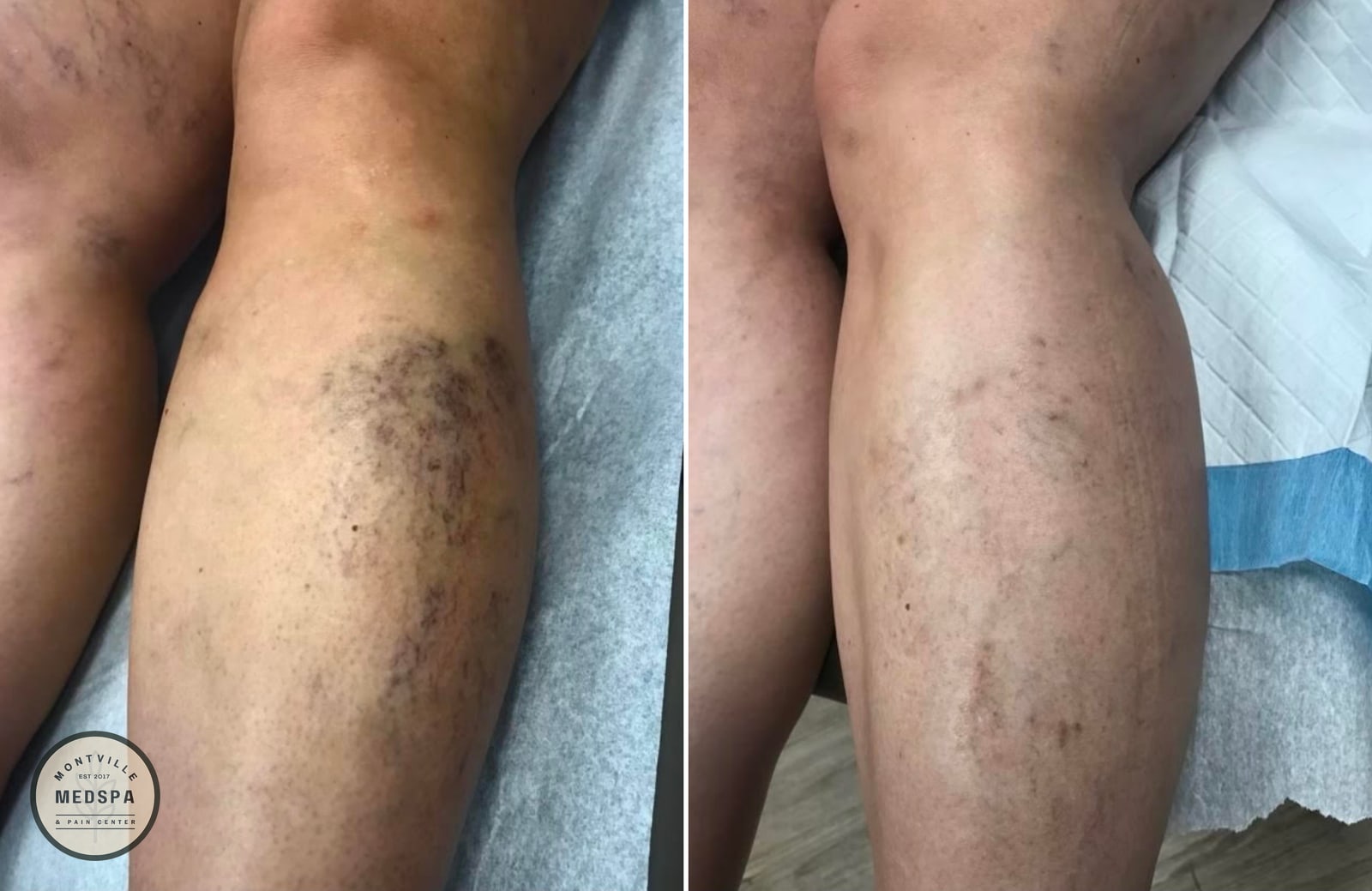
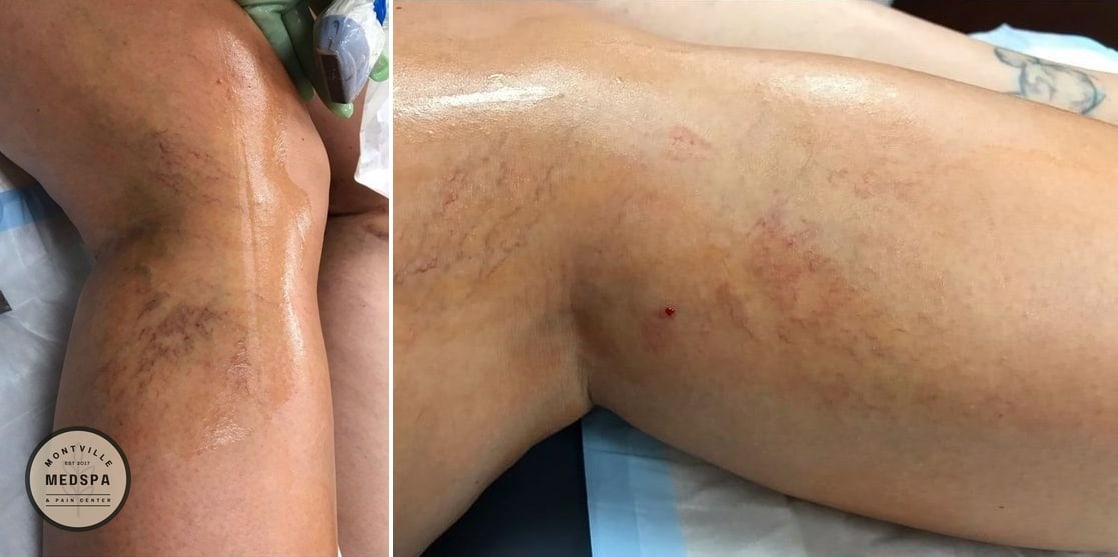
For two to four weeks after a session the treated veins usually look darker, close to bruised. That is the vessel sealing: the solution irritates its lining so the walls stick together, and the body then clears it away. A leg inspected in that stretch looks worse than it did before treatment. The fair time to compare comes after the fade, which takes roughly another four to eight weeks, longer for larger vessels.
What success looks like
- The threads that were treated are gone. A closed vessel is broken down and absorbed, and it usually does not return.
- It does not mean no new ones, ever. The tendency runs strongly in families, and fresh threads can appear over the years. Some people come back for a touch-up now and then; that is a new vein, not a treatment that failed.
- A faint brown mark is its own matter. Once in a while haemosiderin staining lingers for some months before clearing, more often where a healing vein caught the sun — the reason hot baths, saunas and sun are kept off the treated skin for about 48 hours.
When a second session makes sense
Plenty of people see a clear difference after one or two sessions; wide clusters take more, and the larger vessels are the likeliest to need another pass. That call is best made once the first round has finished fading, not while it is still dark.
When refilling points somewhere else
A patch that fills in again in exactly the same place, rather than new threads appearing elsewhere, usually means a larger vein underneath is still feeding it. Dr. Donna D’Alessio looks for that possibility before the first injection — threads crowding the ankle or inner calf, a leg that aches or feels heavy, varicose veins in a parent or sibling — and where the clues are there she maps the leg with a standing duplex ultrasound. A leaking vein it turns up is closed first, with Varithena, so the surface work has a chance to last.
Clifton patients ask
Will insurance pay for any of it? Threads treated purely for appearance are usually classed as cosmetic. A refluxing vein found on the scan is a separate, medical question that plans often cover, and you hear which applies before you commit — see insurance and fees.
How do I get there? Head west from Clifton on Route 3 and Route 46 to 624 Main Road, Suite 2B, Towaco.
More about spider veins, or spider vein care for neighbouring Little Falls, Woodland Park, Paterson and Montclair.
Real results
Before & after
Photos of real patients, shared with their written consent. Results vary from person to person.
Tell us what’s going on
A consultation is a conversation and an examination, not a sales appointment. Dr. D’Alessio will tell you what she thinks is causing it, what can be done about it, and — when that is the honest answer — that you do not need a procedure.