
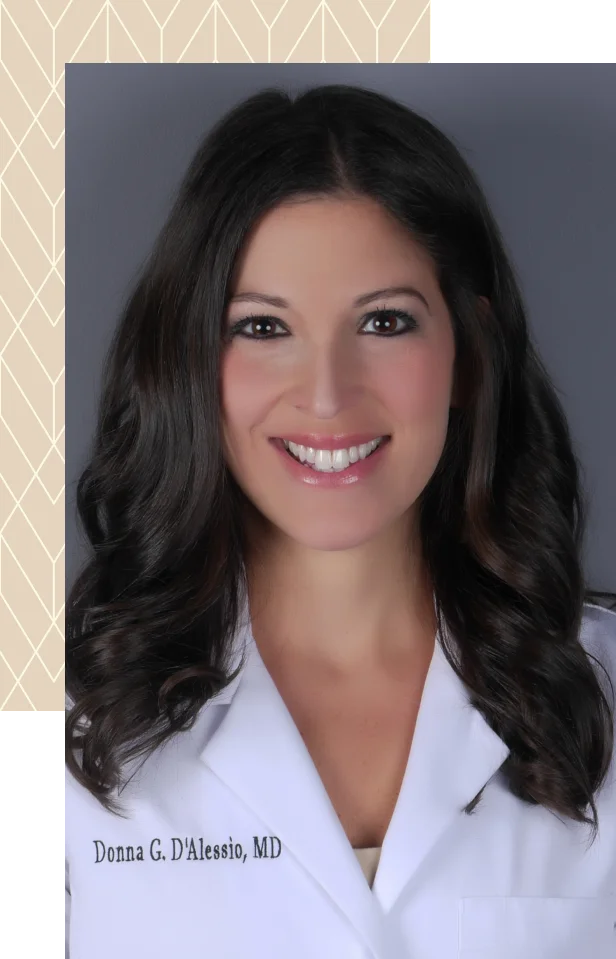
Donna D’Alessio, MD
Montville Pain & Veins:
Aching legs are not just part of the job
If a working life on your feet has caught up with you, that is treatable. Heavy, aching legs and the back pain that comes with them, examined and treated without surgery by Dr. Donna D’Alessio — board-certified in Physical Medicine & Rehabilitation, and the area’s premier pain management physician.
No referral needed to book · We check your benefits before anything is scheduled · 624 Main Rd, Suite 2B, Towaco, NJ 07082

Start here
One question first: why do they hurt?
Almost nobody arrives wanting a vein procedure. They arrive because their legs hurt. That complaint has two common explanations, and they are treated in opposite directions — so the first job is telling them apart.
Most often — the veins
Heavy by the afternoon, better by morning
Aching and heaviness that build through the shift. Ankles with sock marks by the evening, normal again by morning. Cramps at night. Veins you can see. This pattern is venous pressure, and prolonged standing is its classic cause.
Vein care →Or — the spine and joints
Sharp, travelling, worse on sitting
Pain running from the back or buttock down the leg. Pins and needles. Knees on stairs, shoulders overhead, a back that has carried gear for twenty years. Different mechanism, different treatment, same first appointment.
Pain management →Frequently it is one of each — which is exactly why both are examined in one appointment, by one physician, rather than at a vein clinic and a spine practice that never speak to each other.
Who you will see
The area’s premier pain management physician
Donna D’Alessio, MD
Board-certified in Physical Medicine & Rehabilitation. Chief Resident in PM&R at Mount Sinai Hospital. Thousands of vein procedures performed. Recognised by NJ Top Docs.
PM&R is not a well-known specialty outside medicine, and it is the reason patients end up here after everyone else. It is the discipline of restoring function without operating — not what to cut out, but what has stopped working and what gets it back. It is also the single specialty best placed to answer the question this whole page turns on: whether a painful leg is a vein or a nerve.
Very few physicians in Morris County treat both ends of that question, and fewer still have done thousands of vein procedures while being board-certified in the specialty that owns the spine, the joints and the nerves. That combination is the reason to drive past somebody closer.
She will also tell you when you do not need a procedure. That is a less profitable sentence and a more useful one.


What happens
Three appointments, in the usual case
Nothing is recommended before we know what is causing the problem. That sounds obvious and it is the step most often skipped.
- 01
A consultation
What is going on, how long for, what you do all day, and what you can no longer do. Then an examination — legs and back, in the same visit. You leave knowing what we think it is.
- 02
The diagnostic step
For legs, a duplex ultrasound performed standing, because gravity is the load being tested and a scan on a bed can miss it. For the spine and joints, whatever the examination says is needed — often nothing further.
- 03
Treatment, in the office
Under local anaesthetic where anaesthetic is needed at all. No hospital, no general anaesthetic, no overnight stay. You walk out and drive yourself home.
Worth checking, not assuming
You may have out-of-network benefits you have never used
Public-safety, municipal, school-district and union plans frequently include an out-of-network benefit — the plan still contributes when you go outside its network. A great many people who have one have never been told they do.
Whether yours does, what it covers and what you would be responsible for are things we verify and put in front of you before anything is scheduled. If the answer is that your plan will not contribute, you hear that too, plainly.
How out-of-network worksWho we treat
If the job is what did it
Some work is simply harder on legs and backs than other work, and the people doing it get told for years that it is just what happens. It is what happens. It is also treatable, and those are not the same sentence.
Firefighters
Turnout gear, long shifts and hours on your feet load the legs and the spine in ways most jobs do not. Both ends of that get treated here.
What the job does →Police Officers
A duty belt loads the lower back and hips; a shift alternates hours sitting in a vehicle with hours standing still. Both ends show up in the legs.
What the job does →Corrections Officers
Almost the entire shift is spent upright on a hard floor, often for sixteen hours. No job in this list is harder on leg veins.
What the job does →Teachers
On your feet most of the day, with no realistic opportunity to sit, walk properly or put your legs up until the afternoon.
What the job does →Union Trades
Electricians, plumbers, carpenters, steamfitters, operators and labourers — standing on concrete, kneeling, climbing and carrying, for thirty years.
What the job does →Municipal Workers
DPW and sanitation crews, road and utility workers, drivers and operators — standing, lifting, and hours of whole-body vibration in a truck.
What the job does →Nurses & Healthcare
Twelve-hour shifts on hard floors, plus lifting and transferring patients. Most nurses already know it is their veins, and most have never had them mapped.
What the job does →State employees
Desk, field and facility work for the State — a career of either sitting or standing too long, and the back, neck and leg pain that goes with each.
What the job does →Worth saying plainly
One job, and nothing sold alongside it
No aesthetics, no packages, no membership, no treatment plan that quietly grows. A corrections officer whose legs are done by hour eight came here for one reason, and that is the only thing anybody will talk to them about.
Montville Pain & Veins is its own practice, with its own entrance and its own phone line, at 624 Main Rd, Suite 2B.
And on the bill
You will know the number first
Medical vein problems are usually covered; cosmetic ones usually are not. Pain consultations and most injections are covered. PRP generally is not.
We verify your benefits and tell you what we find, including what your plan requires first — before a procedure, not after the bill.
Serving Morris and Essex County
Treatment here runs across a consultation, a diagnostic step, then the procedure and follow-up over some weeks. Twenty minutes away rather than an hour is the difference between finishing a course of treatment and abandoning it halfway.
Tell us what’s going on
A consultation is a conversation and an examination, not a sales appointment. Dr. D’Alessio will tell you what she thinks is causing it, what can be done about it, and — when that is the honest answer — that you do not need a procedure.