
Donna D’Alessio, MD
Montville Pain & Veins · Serving Verona, NJ
Spider Vein Treatment for Verona, NJ
The terms behind fine red and purple leg veins, put plainly — then half-hour sclerotherapy sessions in our Towaco office, up Route 23 from Verona.
No referral needed to book · We check your benefits before anything is scheduled · 624 Main Rd, Suite 2B, Towaco, NJ 07082
A short glossary before your visit
Spider vein care comes with a vocabulary of its own, and meeting it for the first time across an examination couch helps nobody. These are the words you are most likely to hear at Montville Pain & Veins, what each one means, and why it matters for your legs.
Telangiectasia
The medical name for a spider vein. It is a tiny vessel in the skin, usually narrower than a millimetre, that has widened until it shows — red or blue-purple, lying flat rather than raised, and often spreading like a web over the thigh, calf or ankle. The tendency is strongly inherited, and pregnancy, hormonal change and long hours on your feet all encourage it.
Reflux and the feeder vein
Reflux means blood slipping back down a vein whose valves have stopped closing. When that happens in a bigger vein higher up the leg, its pressure can be passed down into the fine vessels at the surface and keep them topped up. That bigger vein is the feeder. The hints that one may be at work:
- clusters crowded at the ankle or along the inner calf
- a leg that also aches or feels heavy
- veins that reappeared after an earlier course of treatment
- varicose veins in a parent or sibling
Duplex ultrasound
The scan that looks for a feeder. You stand while a probe and cool gel trace the veins for around thirty minutes, with no needle, dye or radiation. Dr. Donna D’Alessio suggests it only when the hints above are present; without them, looking at your legs is the whole assessment. More on the scan.
Sclerosant and sclerotherapy
The sclerosant is the solution; sclerotherapy is the treatment that delivers it, through a very fine needle, into each vein in turn while you lie down. It irritates the vessel’s lining so the walls stick together, and over the next few weeks the body takes the closed vein away. A session runs to about half an hour without anaesthetic.
Compression
The stockings fitted before you stand up. Expect to keep them on day and night for the first day and through the daytime for roughly a week after, unless you are told otherwise.
Haemosiderin staining
A small brown mark that occasionally stays for some months where a vein was treated. Sunlight on a vein that is still healing makes it likelier, which is the reason behind the advice to keep the area out of direct sun. The darkening of the first two to four weeks is a different thing: that is the vein closing, and it fades over roughly four to eight weeks after.
Verona patients ask
Which of these words decides what I pay? A telangiectasia treated for how it looks is cosmetic, and plans usually decline it. Reflux in a feeder vein is a medical question that plans often cover. You are told which applies before you commit — see insurance and fees.
Can I walk the West Essex Trail the day after a session? Yes. Walking is encouraged from the moment you leave; it is hot baths and saunas that wait about two days, and strenuous exercise a few.
Where is the office? At 624 Main Road, Suite 2B, Towaco, reached from Verona by Route 23.
More about spider veins, or the same care for neighbouring North Caldwell and West Orange.
Real results
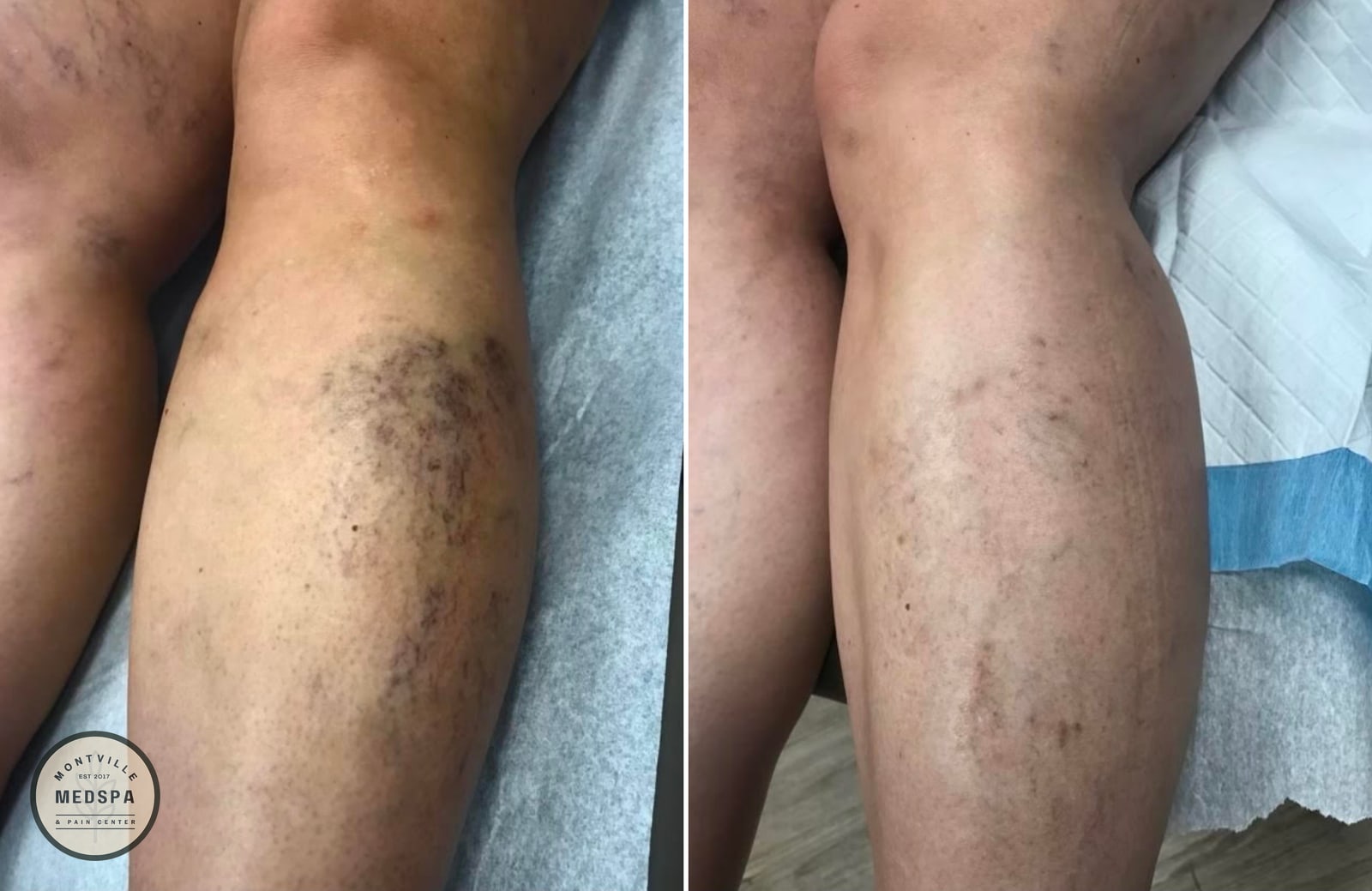
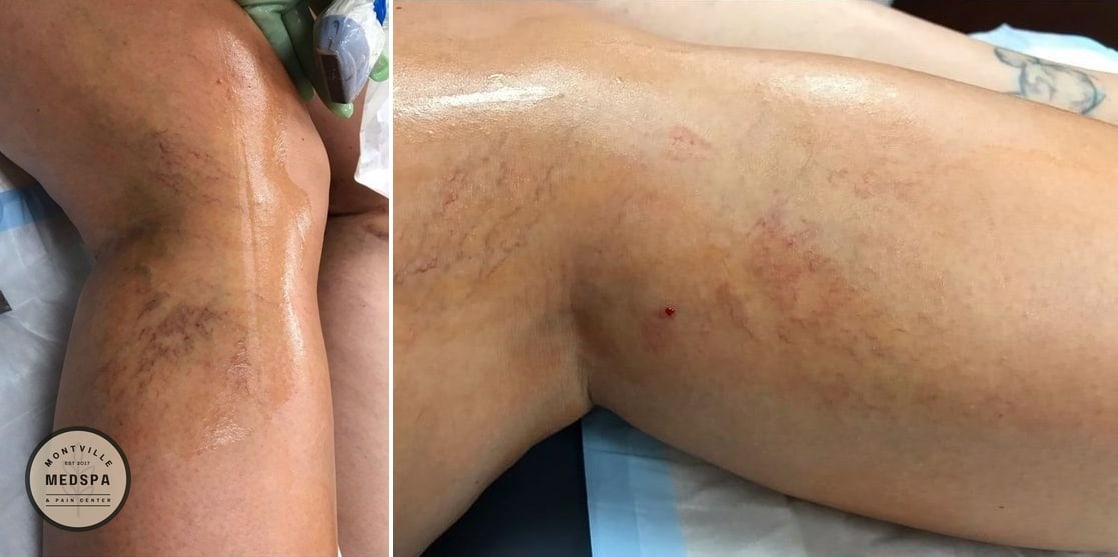
Before & after
Photos of real patients, shared with their written consent. Results vary from person to person.
Tell us what’s going on
A consultation is a conversation and an examination, not a sales appointment. Dr. D’Alessio will tell you what she thinks is causing it, what can be done about it, and — when that is the honest answer — that you do not need a procedure.