
Donna D’Alessio, MD
Montville Pain & Veins · Serving Springfield, NJ
Spider Vein Treatment for Springfield, NJ
Won't my leg need those veins? Where the blood goes once they are closed, answered before any treatment — in Towaco, north of Springfield.
No referral needed to book · We check your benefits before anything is scheduled · 624 Main Rd, Suite 2B, Towaco, NJ 07082
The worry nobody says out loud
A surprising number of people from Springfield ask the same thing at a first visit, sometimes only at the end: if these little veins are closed, what happens to the blood that was in them? It is a fair question. Closing a blood vessel on purpose sounds like something the body ought to object to. It does not, and the reason is worth knowing before you decide anything.
Where the blood goes instead
Spider veins — telangiectasias — are tiny vessels just under the skin that have widened enough to show, usually under a millimetre across. They carry very little and do it badly. When sclerotherapy seals one, a fine needle places a small amount of solution inside it, the lining is irritated, the walls stick together, and over the following weeks the body breaks the closed vessel down and absorbs it. Blood that would have passed through it simply takes one of the many healthy veins nearby.
The leg has far more venous capacity than it needs. That spare capacity is why taking away a vein costs the leg nothing, and why a treated area does not swell or ache from the loss.
What it does not do
- It does not push the problem elsewhere. Healthy neighbouring veins take the flow without strain.
- It does not stop new ones forming. The tendency runs strongly in families, and pregnancy, long hours standing and hormonal change all play a part. New spider veins can appear in other places over the years.
- It does not fix a feeder. If a larger vein higher up has failing valves, it keeps pushing pressure into the surface. Treat only the threads, and they refill.
That last point is why Dr. Donna D’Alessio looks for clues first: clusters around the ankle or inner calf, legs that ache or feel heavy, veins that came back after earlier treatment, or varicose veins in the family. Where those are present, a standing duplex ultrasound comes before any injection. Where they are not, no scan is suggested.
Cosmetic or medical — said plainly
Spider veins on their own are usually treated as cosmetic and are generally not covered by insurance. If the scan shows a refluxing vein feeding them, treating that vein is a separate medical question, often covered, usually with Varithena foam. You are told which applies before you spend anything.
Springfield patients ask
Will the treated area look worse at first? Yes, for a while. Treated veins usually darken and look bruised for two to four weeks, then fade over roughly four to eight weeks.
Can I go straight back to my day? Yes. You walk out in compression stockings, stay out of hot baths and direct sun on the area for about 48 hours, and skip strenuous exercise for a few days.
How many sessions? That depends on how many veins there are and how they respond. Dr. D’Alessio gives an estimate after seeing your legs, not before.
More about spider veins.
Real results
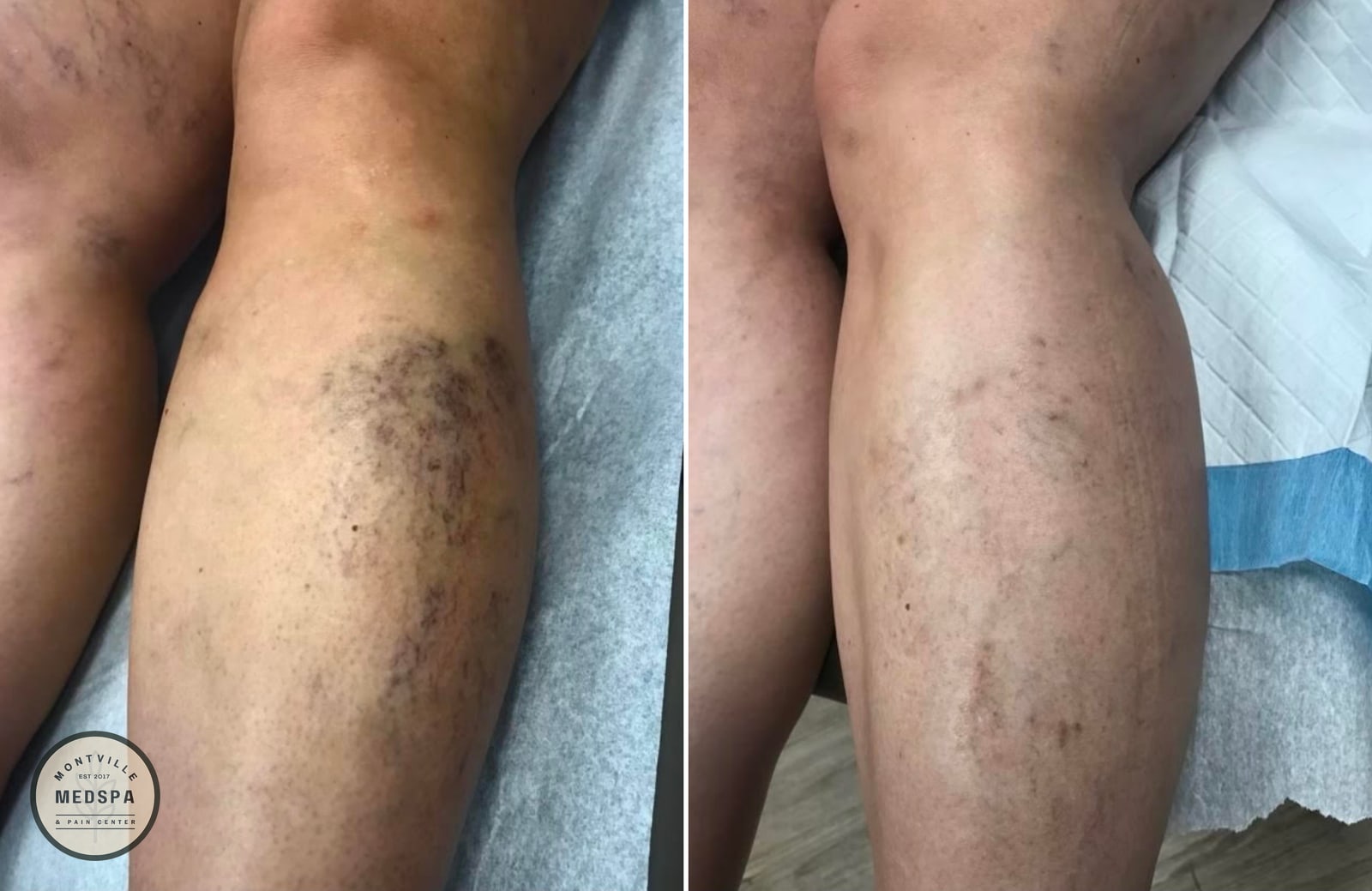
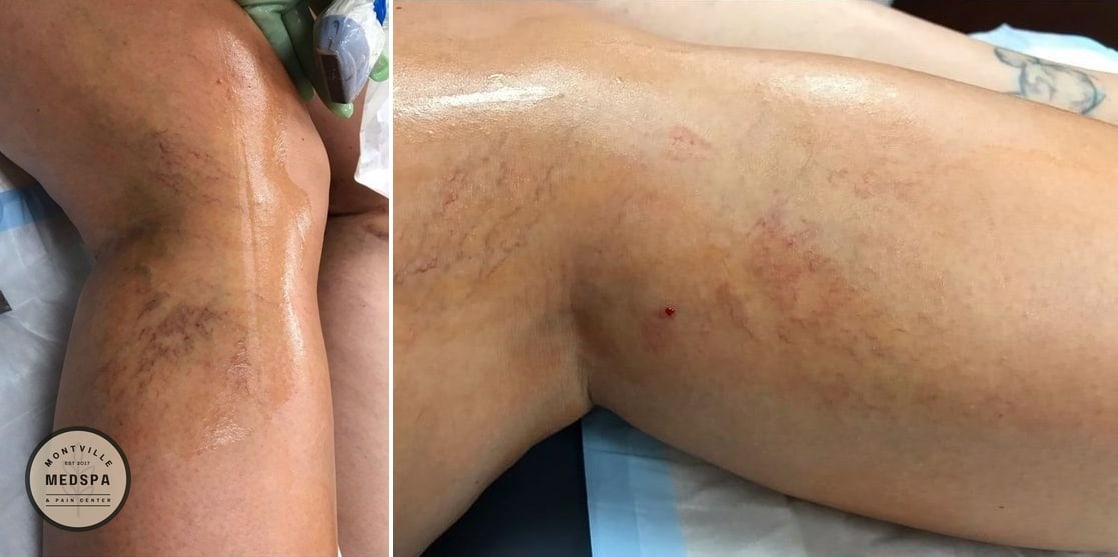
Before & after
Photos of real patients, shared with their written consent. Results vary from person to person.
Tell us what’s going on
A consultation is a conversation and an examination, not a sales appointment. Dr. D’Alessio will tell you what she thinks is causing it, what can be done about it, and — when that is the honest answer — that you do not need a procedure.