

Donna D’Alessio, MD
Montville Pain & Veins · Serving Victory Gardens, NJ
Sclerotherapy for Victory Gardens, NJ
A decades-old injection treatment that is still the standard for spider veins and small varicose branches — now with a check underneath first, in Towaco.
No referral needed to book · We check your benefits before anything is scheduled · 624 Main Rd, Suite 2B, Towaco, NJ 07082
Meant to be temporary
The first homes in Victory Gardens went up in the 1940s as wartime housing, built to be temporary. By 1973, when a project of 184 garden apartments was approved to give the borough permanent homes, those original buildings had long outlasted the lifespan anyone expected of them. Vein treatment has seen its own replacements over the same decades, and one notable survivor.
What was replaced
Stripping pulled a vein out through cuts at the groin and down the leg, under a general anaesthetic, with weeks to recover. It has given way to closing the faulty vein from the inside: Varithena, an FDA-approved microfoam that follows a vein even where it twists or branches. It is done in the office, and Dr. Donna D’Alessio does not strip veins.
What was not
Sclerotherapy has been in routine use for decades, and for spider veins and small varicose veins near the surface nothing newer has reliably done better. A very fine needle places a small amount of sclerosant in the vessel, the solution irritates its lining, the walls stick together, and over the next few weeks the body breaks the sealed vein down.
What has changed around it
The injection is much the same. The thinking around it is not.
- A look beneath the skin when the pattern calls for one. Threads crowded at the ankle or the inner calf, a leg that aches or feels heavy, veins that came back after earlier treatment, or a strong family history lead to a standing duplex ultrasound before any injection. Without those, the examination is the assessment and no scan is suggested.
- The source dealt with first. If the scan finds a refluxing vein feeding the surface, it is closed with Varithena foam, and sclerotherapy becomes the finishing step rather than the whole plan.
- The cost settled up front. Thread veins treated for how they look are usually cosmetic in an insurer’s eyes; a refluxing vein underneath is a separate medical question. Which one applies to you is settled before you commit to anything — see insurance and fees.
A session now
Your history is reviewed first, any past blood clot and the medicines you take included. Then you lie down, the skin is cleaned and the veins are treated one at a time. Each injection brings a quick sting, or a warm cramp in a slightly larger vessel, that passes within seconds. Around half an hour later the stockings are on and you walk out.
Wear the stockings around the clock for the first day and through the daytime for roughly a week. Walk every day. Keep hot baths, saunas and sun off the treated skin for about two days, and put strenuous exercise off for a few. The treated veins look darker, almost bruised, for two to four weeks, then fade over roughly four to eight. Now and then a small brown mark lingers for some months, likelier where a healing vein met the sun.
Victory Gardens patients ask
How many sessions will I need? That turns on how much there is to treat and how the veins respond. Plenty of legs look far clearer after a session or two, and the estimate comes once your legs have been examined by Dr. D’Alessio, board certified in Physical Medicine & Rehabilitation.
Where is the office? At 624 Main Road, Suite 2B, Towaco.
More on the main sclerotherapy page and on spider veins, or sclerotherapy for neighbouring Randolph.
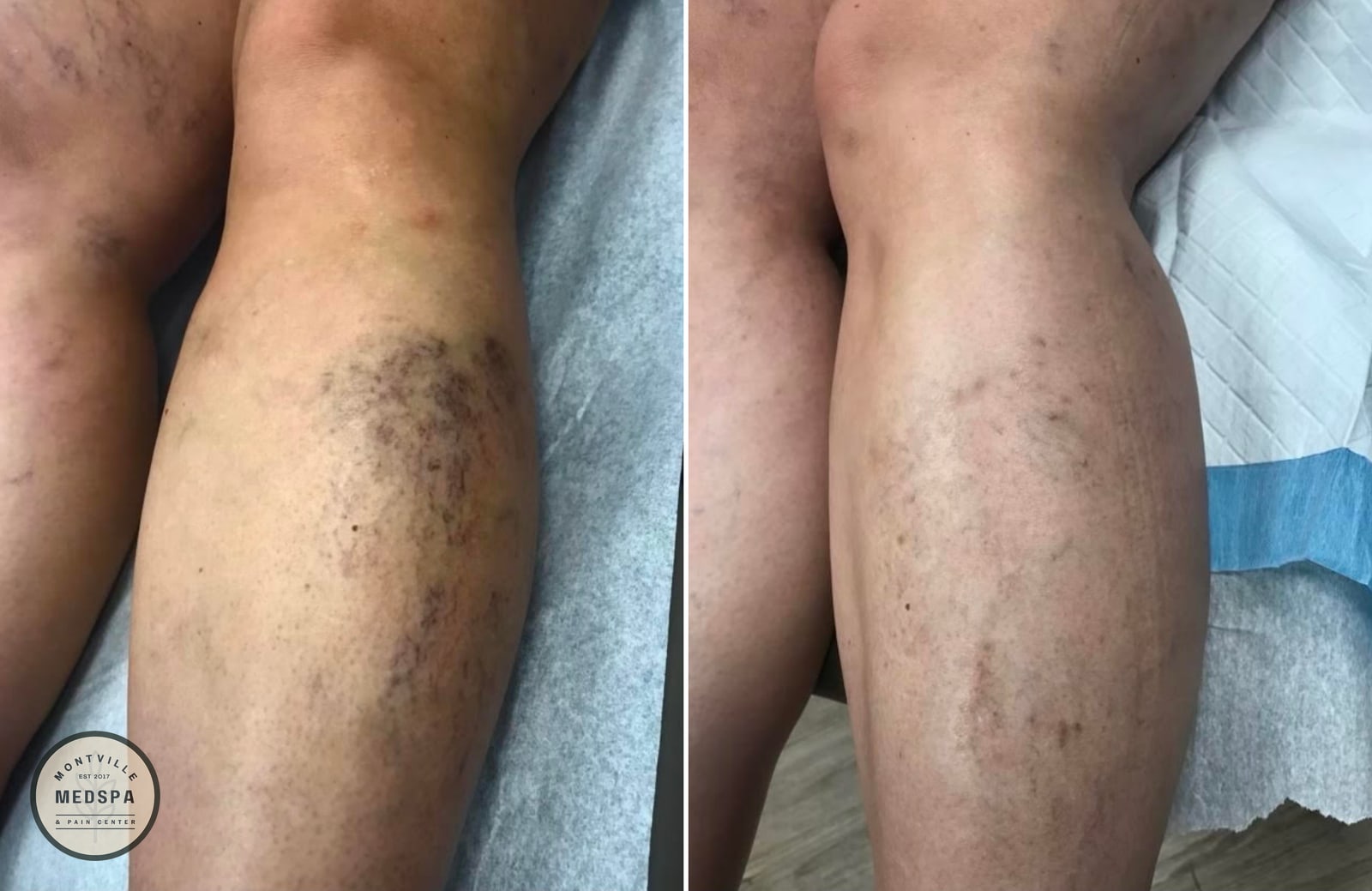
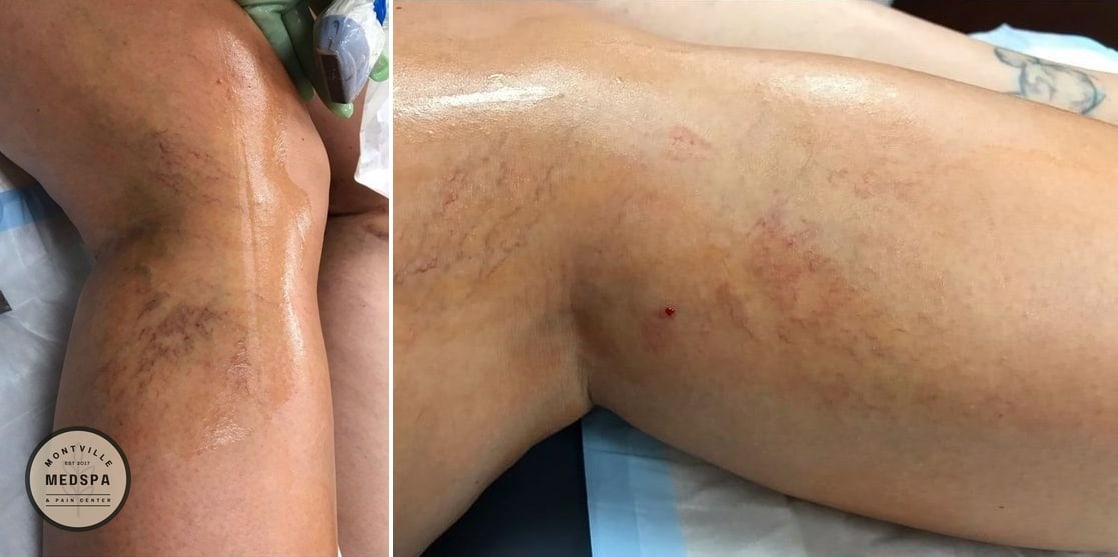
Real results
Before & after
Photos of real patients, shared with their written consent. Results vary from person to person.
Tell us what’s going on
A consultation is a conversation and an examination, not a sales appointment. Dr. D’Alessio will tell you what she thinks is causing it, what can be done about it, and — when that is the honest answer — that you do not need a procedure.