

Donna D’Alessio, MD
Montville Pain & Veins · Serving Wyckoff, NJ
Spider Vein Treatment for Wyckoff, NJ
Before you pick who clears your spider veins, know what to ask — and hear our answers in Towaco, near Wyckoff.
No referral needed to book · We check your benefits before anything is scheduled · 624 Main Rd, Suite 2B, Towaco, NJ 07082
Shopping for spider vein treatment
Spider veins are tiny vessels in the skin, generally narrower than a millimetre, that have widened enough to show red, blue or purple on the thighs, calves or ankles. They are common, and choosing who treats yours deserves a little thought. A few straightforward questions tell you how carefully any of them will plan the work. These are the ones worth asking, with the answers Montville Pain & Veins gives.
1. “Will anybody check whether something is feeding them?”
It matters because some spider veins are kept full by a larger vein further up the leg whose valves have failed, and threads injected over a source like that fill in again. Here the clues are looked for at the first visit: clusters crowded at the ankle or inner calf, an ache or heaviness in the same leg, a patch that returned after earlier injections, and varicose veins in a parent or sibling. Any one of them means a standing duplex ultrasound before treatment. None of them, and no scan is put on your bill.
2. “Is mine cosmetic or medical, and when will I know?”
You should know before you pay anything. Threads treated purely for their looks are a cosmetic procedure that insurers usually decline. A refluxing vein found on the scan is a medical problem, which plans often cover, and closing it with Varithena is costed separately from the surface work. See insurance and fees.
3. “How many sessions, and who decides?”
Be wary of a number given before anyone has seen your legs. It depends on how many veins there are and how each one responds; plenty of people see a clear change after one or two sessions, while broad webs need more. Dr. Donna D’Alessio, board certified in Physical Medicine & Rehabilitation, gives her estimate after examining you.
4. “What will my legs look like in between?”
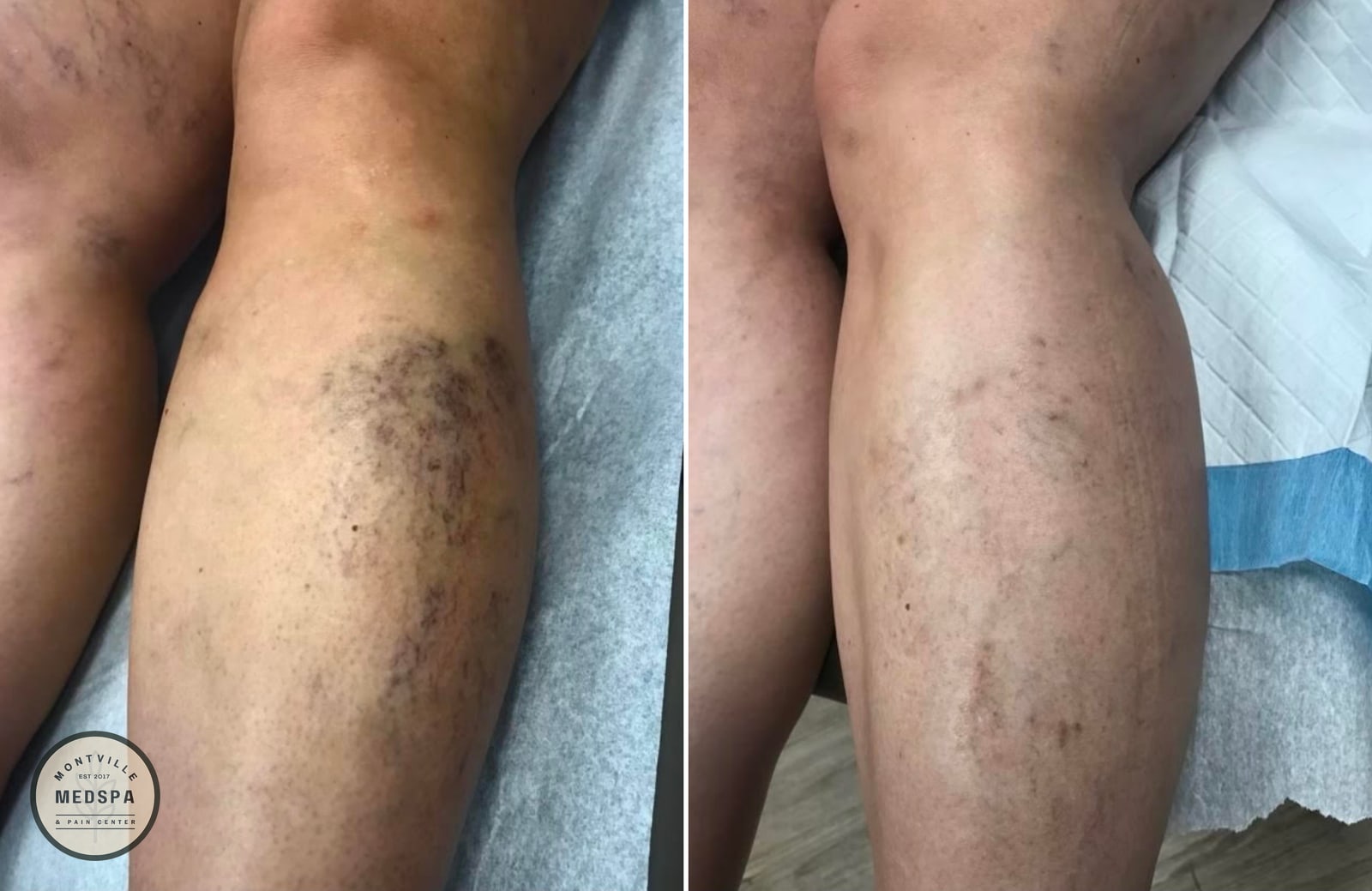
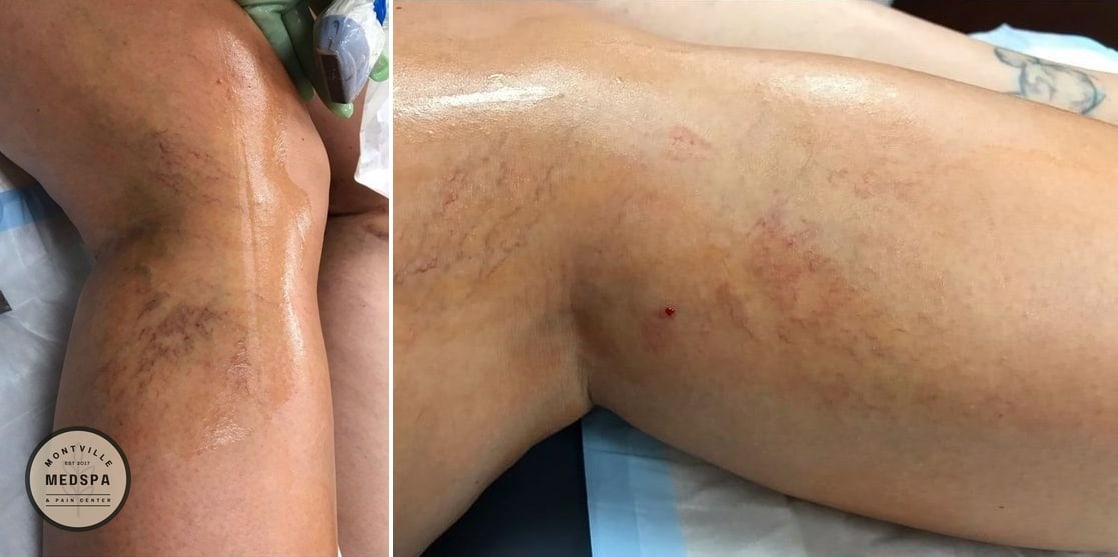
A careful practice warns you that results arrive slowly. After sclerotherapy — half an hour of injections through a very fine needle, no anaesthetic — treated threads usually look darker, almost bruised, for two to four weeks while they close, then fade over roughly four to eight. Sun on a healing vein can leave a brown mark that stays for months.
5. “What happens in a year or two?”
A closed vein is absorbed and usually does not come back. New ones can still appear, especially where the tendency is inherited, and you should be told that at the outset rather than discover it later.
Wyckoff patients ask
Can a session fit around a working week? Tuesdays run until 7 pm and Saturdays from 9 am to 1 pm; other weekdays open at 9 am.
Where is the office? At 624 Main Road, Suite 2B, Towaco.
More about spider veins, or the same care for Wyckoff’s neighbours Franklin Lakes and North Haledon.
Real results
Before & after
Photos of real patients, shared with their written consent. Results vary from person to person.
Tell us what’s going on
A consultation is a conversation and an examination, not a sales appointment. Dr. D’Alessio will tell you what she thinks is causing it, what can be done about it, and — when that is the honest answer — that you do not need a procedure.